


Table of Contents
- Appliance Repair vs Replacement: How to Decide
- Appliance Repair vs Replacement Cost: What to Compare
- Average Appliance Lifespan by Type
- The 50% Rule for Appliance Repair
- Dishwasher Repair Cost: A Worked Example
- Warranty, Parts Availability, and Repairability
- Safety and Urgent Replacement Criteria
- Total Cost of Ownership and Energy Savings
- Frequently Asked Questions
Last Updated: October 19, 2026
Appliance Repair vs Replacement: How to Decide
The appliance repair vs replacement guide starts with one question: will a fix buy you years of service, or just weeks? We walk homeowners through that call every day, and the answer rarely comes down to price alone.
Repair usually wins when the unit is young, the fault is minor, and parts are easy to get.
Below, we break down the repair cost and replacement cost comparison, average lifespan by appliance type, the 50% rule, and a worked dishwasher example.
Appliance Repair vs Replacement Cost: What to Compare
Most homeowners compare one number: the repair estimate against the price of a new unit. That comparison is incomplete, line up every cost on both sides before you decide.
A fair appliance repair vs replacement cost comparison includes:
- Diagnostic fee for the visit and assessment
- Labor cost for the repair itself
- Parts cost, including any special-order items
- Replacement purchase price for a comparable model
- Installation costs, delivery, and haul-away of the old unit
- Energy consumption of the old unit versus a new one
Add both sides. The lower total is not automatically the winner, but it is the honest starting point.
Repair Estimate Line Items and Replacement Line Items
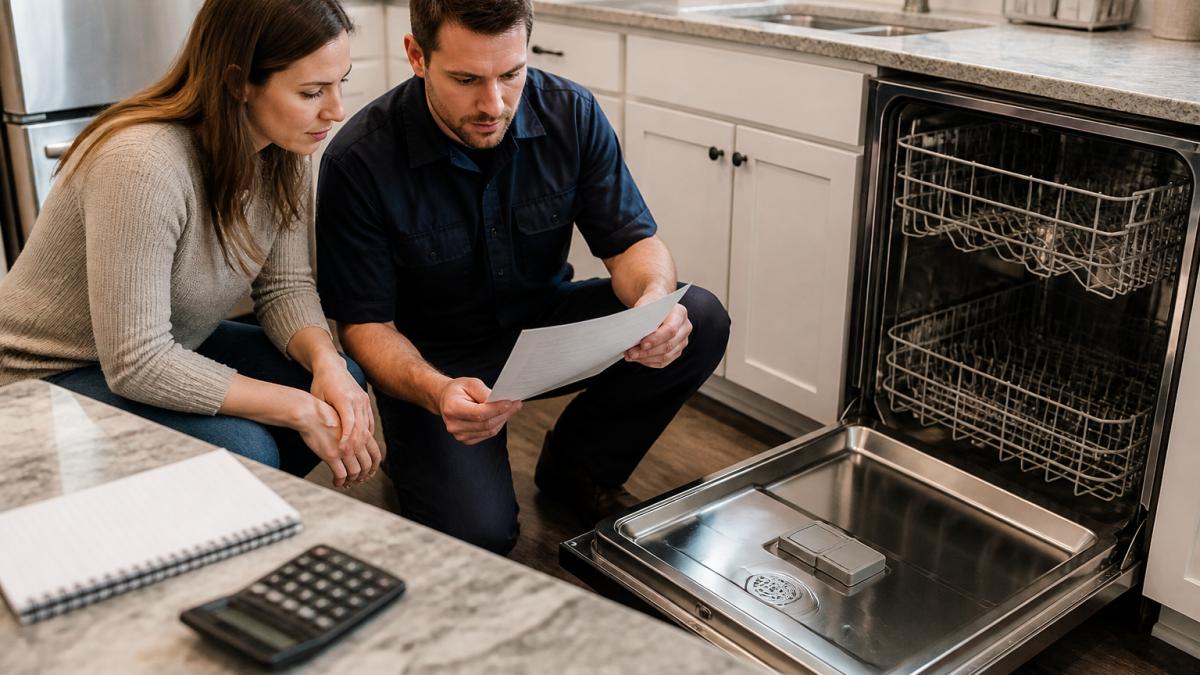
Ask for the repair estimate in writing, broken into parts and labor, with the part name, part number, labor time, and any service call charge.
On the replacement side, price the new unit plus delivery, installation, and disposal, buyers often forget the last two, and they add real money.
Average Appliance Lifespan by Type
Average appliance lifespan is the baseline for every repair-versus-replace call. Once a unit passes its expected service life, each repair buys less future use. The table below pairs typical lifespan ranges with practical repair thresholds so you can apply the guidance to your specific unit.
| Appliance | Typical Average Lifespan | Repair Leans Toward | Replace Leans Toward |
|---|---|---|---|
| Refrigerator | 10-15 years | Repair under 8 years | Replace past 12 years |
| Dishwasher | 8-12 years | Repair under 6 years | Replace past 10 years |
| Washing machine | 8-12 years | Repair under 6 years | Replace past 10 years |
| Dryer | 8-12 years | Repair under 6 years | Replace past 10 years |
| Oven or range | 12-18 years | Repair under 10 years | Replace past 15 years |
| Microwave | 7-10 years | Repair rarely worth it past 7 years | Replace past 7 years |
| Water heater (tank) | 8-12 years | Repair under 6 years | Replace past 10 years |
| Garbage disposal | 8-12 years | Repair under 6 years | Replace past 10 years |
| Range hood | 10-15 years | Repair under 8 years | Replace past 12 years |
These are general ranges, not hard rules. Adjust for how hard the unit works: a refrigerator in a busy household may wear faster than the range suggests, while a lightly used second refrigerator may last well beyond it.
Remaining useful life and breakdown frequency
Remaining useful life is how many good years the unit likely has left. To estimate it, subtract the unit's age from the midpoint of its typical lifespan range. A 9-year-old dishwasher with an 8-12 year range has a midpoint of 10, leaving roughly one year of expected service, a signal that a major repair may not pay off.
Breakdown frequency matters just as much. One repair in eight years is normal wear; three in two years is a pattern, and patterns point to replacement.
Appliance-specific decision notes
Some appliances carry nuances a single lifespan number cannot capture. Refrigerators with sealed compressor systems often justify repair up to year 8 because the sealed system is the most expensive component and a similar-capacity replacement may cost significantly more.
Use the table and these notes together. Young unit with a minor fault: repair. Past the replace threshold with a major repair: replace. The gray zone in between is where the 50% rule and a written estimate do the most work.
The 50% Rule for Appliance Repair
The 50% rule is a simple filter: if the repair cost is more than half the price of a new appliance, lean toward replacing it. It is a quick gut check, not a law of physics.
In practice, if the repair estimate comes in above half the price of a comparable new unit, the repair has to justify itself with remaining life. If the unit is old, it rarely does.
The rule is most useful as a first pass, stopping you from pouring money into a machine near the end of its life.
Where the 50% Rule Breaks Down
The 50% rule fails in three situations.
First, high-end appliances. A premium refrigerator can justify a larger repair because replacing it costs far more than a standard model.
Second, minor repairs on young units. A small fix on a two-year-old machine is almost always worth it, even if the percentage looks high on a cheap appliance.
Third, safety issues. If the fault involves wiring, gas, or a recall, cost stops being the deciding factor.
Dishwasher Repair Cost: A Worked Example
Dishwasher repair cost is the clearest way to see the decision in action. Picture a 9-year-old dishwasher that will not drain.
The repair is a fraction of the replacement total, so the 50% rule says repair. But the unit is 9 years old, near the top of its 8-12 year range.
Our read: at 9 years with one major repair, repair is reasonable if the rest of the machine is sound. Past 10 years with a second failure, replace.
Warranty, Parts Availability, and Repairability
Warranty coverage and parts availability can flip a close call. Check both before you commit to a repair.
- Manufacturer warranty: still active? A covered repair may cost you little or nothing.
- Repair warranty: ask how long the shop stands behind the fix.
- Parts availability: discontinued parts can turn a simple fix into a dead end.
- Repairability: some models are built so parts are hard to reach, which raises labor.
A unit with no warranty, scarce parts, and a sealed design is a poor repair candidate no matter the age.
Safety and Urgent Replacement Criteria
Some faults are not a cost question but a safety question, and they call for urgent replacement.
Replace rather than repair when you see:
- Burning smells, scorch marks, or melted wiring
- Sparking, tripping breakers, or repeated shocks
- Gas odors around a range or dryer
- A recall on the model with no fix available
- Water leaks that keep returning after repair
Do not weigh these against a repair bill. Get the unit assessed by a professional and replace it if the risk cannot be fully removed.
Total Cost of Ownership and Energy Savings
Total cost of ownership is the full cost of keeping an appliance, not just the purchase price: repairs, energy consumption, and downtime over the years you own it. Most repair-versus-replace advice stops at the upfront price, which is why so many homeowners second-guess the decision later. A total-cost comparison over a defined period makes the trade-off visible.
How to calculate total cost of ownership
Use a five-year window. On the repair side, add the repair estimate, any uncredited diagnostic fee, and an allowance for likely future repairs. On the replacement side, add purchase price, delivery, installation, haul-away, and any permit or hookup fees, then subtract resale or scrap value. Estimate annual energy use for both units and multiply by your local rate, then add any extended warranty or service plan.
The formula looks like this:
- Repair path total = repair estimate + diagnostic fee + (expected future repairs per year × 5) + (old unit annual energy cost × 5)
- Replacement path total = purchase price + delivery + installation + haul-away + (new unit annual energy cost × 5) − resale value
Whichever total is lower over the window is the stronger financial case, though safety, downtime, and convenience still matter.
Energy-use math in practice
Older appliances often use more energy than newer models, and the gap shows up monthly. It is largest for refrigerators, which run continuously, and for dishwashers and washing machines, which heat water.
A refrigerator more than 15 years old commonly uses meaningfully more electricity than a current comparable model. Use rated numbers rather than a rule of thumb; for gas appliances such as ranges and dryers, apply the same logic using therms and your gas rate.
Worked example: repair versus replace a refrigerator
Suppose a 13-year-old refrigerator needs a $450 repair, and a comparable new unit costs $1,200 plus $150 delivery and installation and $50 haul-away, for a replacement total of $1,400.
On the repair path, assume the repair plus one likely future repair averages $150 per year over five years, plus $112 per year in energy, for a five-year total of about $1,310.
Run the same math with your own numbers, the result often surprises homeowners focused only on the repair bill.
When repair still wins on total cost
Total cost of ownership does not always favor replacement. A young appliance with a minor fault, a high-efficiency model that is already near current standards, or a premium unit with expensive replacement equivalents can make repair the lower-cost path over five years. The calculation is a tool, not a verdict, use it to see the full picture, then weigh safety, downtime, and your own plans for the home.
Frequently Asked Questions
Is it cheaper to repair or replace an appliance?
It depends on the repair estimate relative to replacement. A common starting point is the 50% rule: if the repair costs more than half the price of a comparable new appliance, replacement usually wins. Factor in the appliance's age against its average appliance lifespan, how many repairs it has needed recently, and whether the fix restores full performance. A single minor repair on a mid-life appliance is almost always cheaper than replacing it, while a major repair on an appliance near the end of its expected lifespan rarely pays off.
What is the 50% rule for appliance repair?
The 50% rule says you should replace an appliance when a repair estimate exceeds half the cost of a new one. It works as a quick screen, not a hard law. A $300 repair on a $700 dishwasher crosses the line and points toward replacement. The same $300 repair on a $2,000 refrigerator does not. Adjust the rule for age, remaining useful life, and energy efficiency: an old appliance that is also driving up utility bills can justify replacement even below the 50% threshold.
How old should an appliance be before you replace it?
Compare the appliance's age to its average appliance lifespan rather than using a single cutoff. Refrigerators typically last around 13 years, dishwashers about 9, and washing machines roughly 10. Past those ranges, repairs become less predictable and parts availability can shrink. An appliance within its expected lifespan that needs one repair is usually worth fixing. One that is well past its lifespan and breaking down repeatedly is a stronger replacement candidate, especially if the repair estimate is climbing.
How do I compare an appliance repair estimate with the replacement cost?
Ask the technician to break the estimate into parts, labor, and the diagnostic fee, and confirm whether the diagnostic fee is credited toward the repair. Then price a comparable new unit and add installation, haul-away, and any delivery charges. Compare the full replacement total against the repair total, not just the sticker price of the new appliance. If the repair keeps the appliance running for several more years, divide the repair cost by those expected years to see the annual cost before deciding.
The hardest part of repair versus replacement is trusting the estimate in front of you. Repair Appliance Pro makes that easier with background-checked technicians, same-day or next-day availability, and honest assessments that tell you when a fix is not worth it. Our team services refrigerators, washers, dryers, dishwashers, and ovens, with secure contactless online payment and clear diagnostic fees. Contact us now to book a visit and get a straight answer on your appliance.

